ByJohn A
Inside an Espresso Machine: Portafilters, Boilers, and Steam Wands Explained
To the uninitiated, an espresso machine can look like a intimidating piece of industrial machinery, complete with gleaming stainless steel, pressure gauges, levers, and steaming wands. Yet, despite the sleek modern designs and complex engineering under the hood, every espresso machine relies on a few fundamental components working in harmony to pull a rich shot of espresso or texture milk.
Demystifying these internal components helps demystify the brewing process itself. Whether you are troubleshooting your morning routine or shopping for an upgrade, understanding how portafilters, boilers, and steam wands function empowers you to craft consistently delicious coffee at home.
The Portafilter: The Heart of Extraction
The portafilter—short for “portable filter”—is the heavy handle and filter basket assembly that holds ground coffee during extraction. It locks directly into the machine’s grouphead, creating a high-pressure seal capable of withstanding the 9 bars of pressure required to make authentic espresso.
A portafilter consists of several key elements:
- The Handle: Engineered for ergonomics and heat resistance, allowing you to lock and unlock the assembly safely.
- The Filter Basket: A removable stainless steel cup perforated with tiny, laser-cut holes that allow liquid coffee to flow through while retaining the ground coffee bed.
- The Spouts or Bottomless Design: Traditional portafilters guide extracted espresso through spouts into your cup. Bottomless (naked) portafilters expose the underside of the filter basket, letting baristas visually diagnose channeling issues and observe crema formation in real time.
Because espresso extraction relies heavily on thermal mass, commercial-grade portafilters are forged from thick chrome-plated brass or stainless steel to retain heat throughout the extraction process.
The Boiler: Thermal Engine and Pressure Reservoir
If the portafilter is where extraction happens, the boiler is the engine driving it. An espresso machine boiler heats water to precise temperatures and, depending on machine design, generates the high-pressure steam needed for milk texturing.
There are three primary boiler configurations found in modern home espresso equipment:
- Single Boiler Systems: A single water chamber handles both brewing (around 200°F / 93°C) and steaming (above 250°F / 121°C). While compact, users must wait for the boiler to heat up or cool down between brewing coffee and frothing milk.
- Heat Exchanger (HX) Systems: A single large boiler maintains high temperatures for steaming, while a copper pipe carrying fresh water passes through it to heat brew water on demand.
- Dual Boiler Systems: Two independent boilers operate side by side—one dedicated solely to precise brewing temperatures, and the other to high-pressure steam output.
Modern high-performance boilers are regulated by PID (Proportional-Integral-Derivative) controllers. These digital thermostats monitor water temperature continuously, applying subtle electrical pulses to maintain water within a fraction of a degree of your target setting.
To get the most out of these internal components, learning the nuances of grinding, tamping, and extraction timing is essential. Mastering how to make espresso at home requires dialing in these variables alongside your equipment’s thermal capabilities.
The Grouphead: The Water Distribution Hub
The grouphead (or brew group) is the front-facing metal assembly where the portafilter locks into place. It serves as the bridge between the internal boiler system and your coffee grounds.
Inside the grouphead sits a shower screen and dispersion block. When the pump engages, pressurized hot water flows into the grouphead, where the dispersion block evenly spreads water across the shower screen. This ensures the coffee puck is saturated uniformly rather than blasted by a harsh central stream, preventing water from carving channels through the coffee bed. Many iconic groupheads, like the famous E61 design, continuously circulate hot water through their solid brass casting to maintain thermal stability.
The Steam Wand: Crafting Microfoam Texture
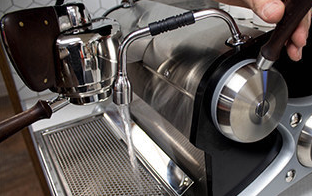
Extracted espresso is only half the equation for latte and cappuccino lovers. The steam wand is a metal tube connected directly to the steam boiler or thermoblock, designed to inject hot, dry steam into milk.
A steam wand operates through two simultaneous actions:
- Aeration (Stretching): Introducing micro-bubbles of air into cold milk during the first few seconds of steaming to expand its volume.
- Texturing (Rolling): Creating a deep vortex inside the milk pitcher to break those air bubbles down into ultra-fine microfoam, resulting in a glossy, wet-paint texture.
The tip of the steam wand features one to four small holes engineered to optimize steam velocity and direction. Combined with a dedicated steam boiler, a quality steam wand delivers instant, dry steam that textures milk in seconds without adding excess water dilution.
Pumping Pressure and Solenoid Valves
Behind the main heating elements lie two unsung heroes: the pump and the three-way solenoid valve.
The pump (either a compact vibratory pump or a whisper-quiet rotary pump) forces water from the reservoir through the boiler at 9 bars of pressure. Once the shot finishes, the three-way solenoid valve instantly relieves pressure from the portafilter, diverting excess water into the drip tray. This leaves behind a dry, firm coffee puck that is easy to knock out into a dump box.
Understanding how these core espresso machine parts work together allows you to maintain your equipment better, diagnose brewing issues, and make informed choices when upgrading your kitchen coffee bar.
Final Thoughts
An espresso machine is a beautifully coordinated ecosystem of heat, pressure, and fluid dynamics. From the precise temperature management of digital boilers to the mechanical seal of a heavy brass portafilter, every individual component plays a vital role in delivering a clean, sweet, and balanced cup. Demystifying these internal parts turns espresso making from a mysterious guessing game into an enjoyable, repeatable craft.